Floodplains - Part 2
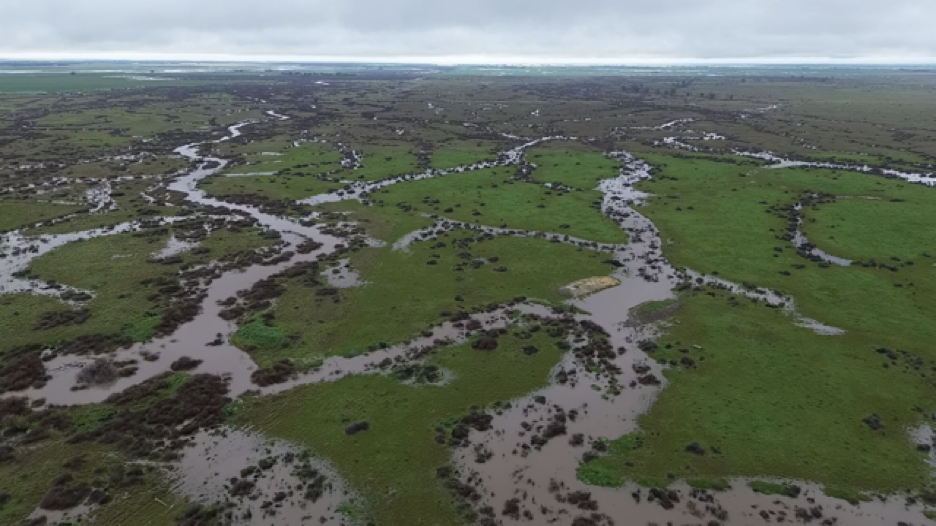
Overbank flows - the power of our floodplains.
With the shortage of water flowing in our rivers of the Murray Darling Basin, People often think that if we stop the flooding on to the floodplains then we are protecting the rivers and the whole system.
But ecologically this is not true. The river system needs connection with the floodplains: it is a crucial element of its naturally functioning system.. Our rivers have evolved to operate as a river-floodplain system with water, nutrients, organisms and carbon moving between the river and the surrounding landscape. Removing the overbank flows progressively simplifies the system with the river becoming just another channel.
When a river rises and water goes over the bank the floodplain breathes with the river. It is a connected healthy system. Our late winter and spring are the times when flooding was most common. In these times there is a corresponding burst of activity, nature flourishes and diversity builds.
Water and sediment moves out from the river over the landscape into wetlands, waterholes, billabongs, gilgais, depressions. Hydrating the landscape and the vegetation that has evolved around periodic flooding - the red gums, black box, lignum, numerous native grasses and forbs.
Floods transport organic matter, nutrients and fine sediments from the river to the landscape and then in turn the floodplains return material to the river. This is an important part of the river system.
Floods create enormous areas of productive and shallow habitat for fish, frogs, birds and insects. These animals have evolved to periodic flooding and so they use these events to feed, breed and then disperse to other areas of the river system. This builds genetic diversity and variation which is crucial for long-term resilience and survival.
Floodplain soils - periodic inundation can build the soil profile of moisture, organic matter, microbial activity and nutrient cycle. Our soils are heavy grey clay soils designed to welcome as much water and nutrients as possible in their profile. And these clay spoils are very effective at storing this moisture for long periods of time on our landscape. When floodplain soils are not receiving the river flows the functioning and capacity of these soils is also altered.
The river needs the floodplains. Its ecological productivity is directly linked to the surrounding floodplains. When the river becomes disconnected it loses a huge area of habitat and biological production
Not every flood is necessarily beneficial. The enormous summer floods of 2011 and 2022 have been catastrophic.
Beneficial floods require the right flows, at the right frequency, magnitude and duration and the right season
Sometimes flooding is catastrophic. The 2011 and 2022 flooding in Summer saw huge (1 in 100 year flow) which inundated the whole landscape, sat there for long periods of time and with the hot weather then baked the soil. This type of flooding (like fire episodes) is not what is wanted - the soil becomes anaerobic with minimal effective biological activity, So soils just “rot” and produce sulfuric acid. The flood plain plants and animals are also not evolved to these conditions and so there is an over-proliferation of just a few species - lignum, red gums, ridgid panic. These proliferate and create monocultures.